

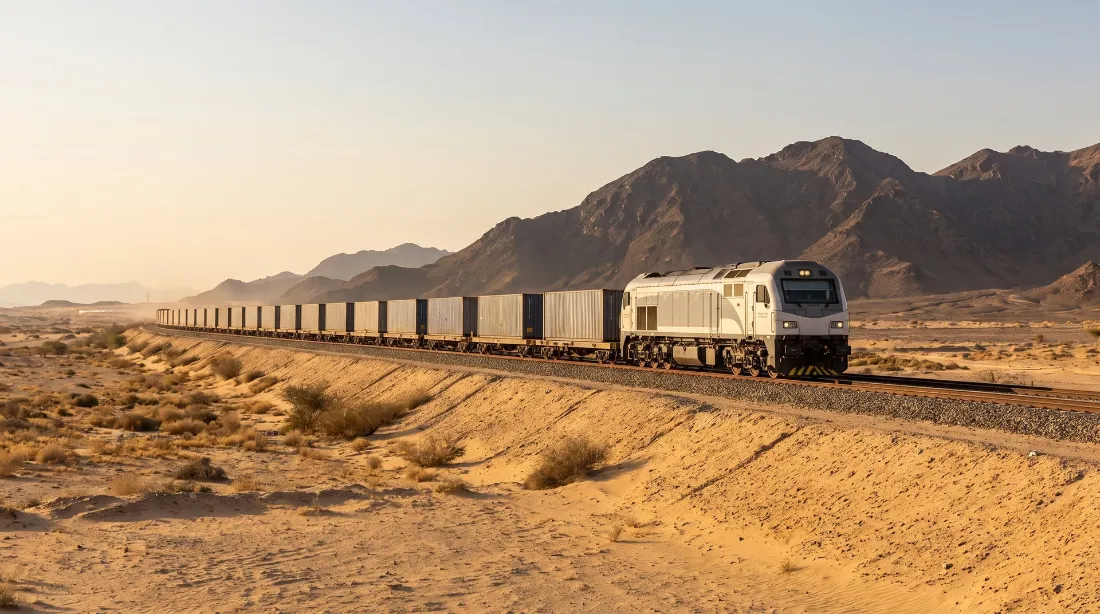
In September 2026 Etihad Rail and AD Ports Group opened a direct rail freight service between Fujairah Terminals, on the UAE’s east coast, and the Industrial City of Abu Dhabi (ICAD). Three departures a week over roughly 200 km of track, with containers inspected, cleared and released inside the industrial zone instead of at the quay. It looks like a transport story. For anyone who lifts, moves and stores goods, it is also a handling story.
What actually changed
Shippers, shipping lines and cargo owners can now book ICAD itself as the final destination of a container. The industrial city has its own UN/LOCODE, AECAD, so it is recognised as a logistics location in its own right. Boxes arrive at Fujairah, go straight onto the train and are processed by customs at the inland terminal, a few kilometres from the factories that will use what is inside them.
Geography matters here. Fujairah sits on the Gulf of Oman, outside the Strait of Hormuz, so the service also gives Abu Dhabi’s industrial base a second maritime gateway that does not depend on a single sea lane.
“Strong trade corridors are built by connecting gateways with the industrial and commercial ecosystems they serve.”
Saif Al Mazrouei · CEO, Ports Cluster, AD Ports Group
A network moving from plan to volume
The Fujairah–ICAD link is one piece of a much larger system. Etihad Rail’s national network runs for about 900 km, from Al Ghuwaifat on the Saudi border to Fujairah, and the operator targets 60 million tonnes of freight a year by 2030.
The volumes are already real. According to the Abu Dhabi Media Office, in just nine days in March 2026 the network ran more than 100 freight trains, carrying 459,000 tonnes of cargo and over 7,900 containers, with capacity redeployed to east coast ports. When the ICAD terminal was first connected in 2022, the UAE Ministry of Energy and Infrastructure indicated a planned annual throughput of 15 million tonnes of bulk cargo, 1.5 million tonnes of general cargo and 116,600 TEU, with round-the-clock operations.
Where the work moves: from the quay to the yard
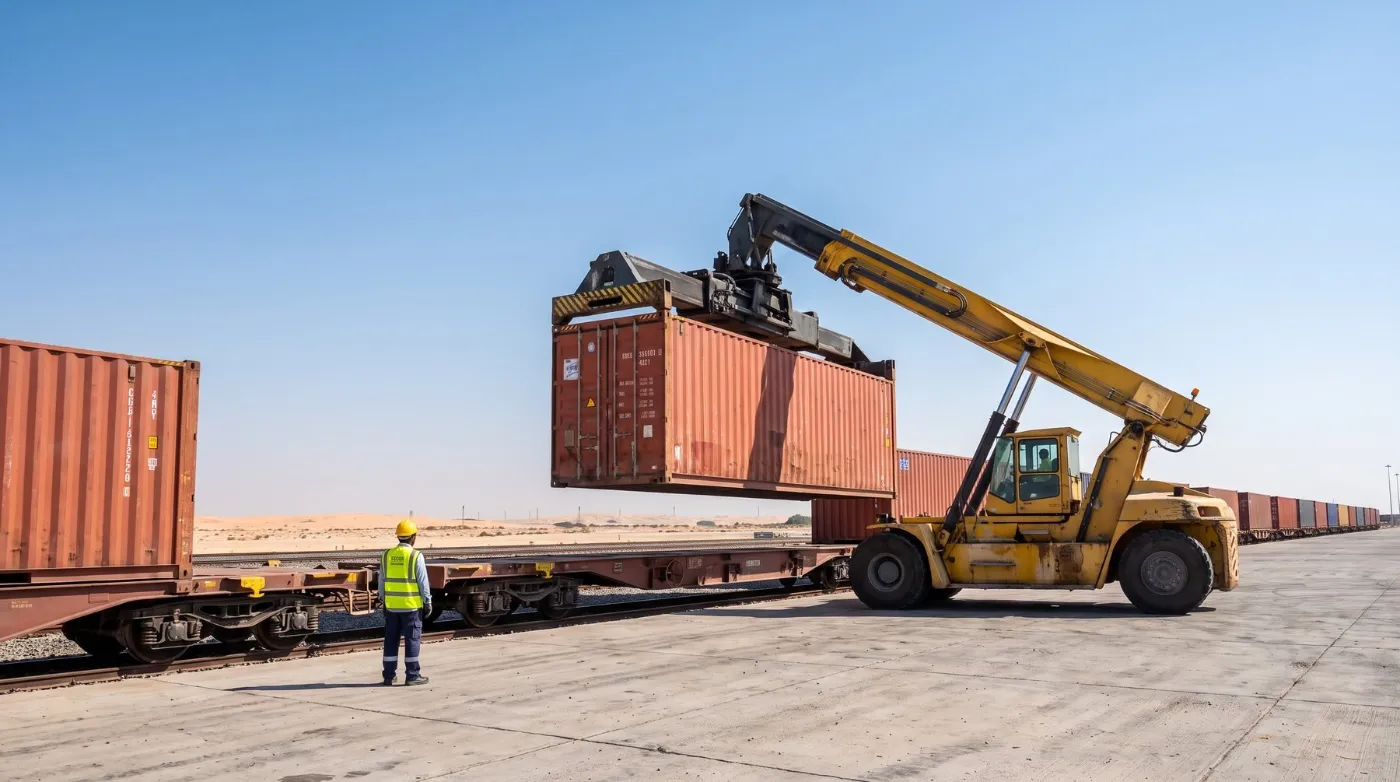
When clearance moves inland, handling moves with it. Containers that used to be unpacked near the port now reach a rail terminal first and a factory gate second. That shifts equipment needs in a few clear directions.
Reach stackers and container handlers
Loading and unloading wagons, stacking full and empty boxes, and feeding trucks for the last kilometre inside the industrial zone.
Heavy-capacity forklifts
Moving dense, heavy loads such as steel coils, machinery and construction materials between the terminal, storage areas and production lines.
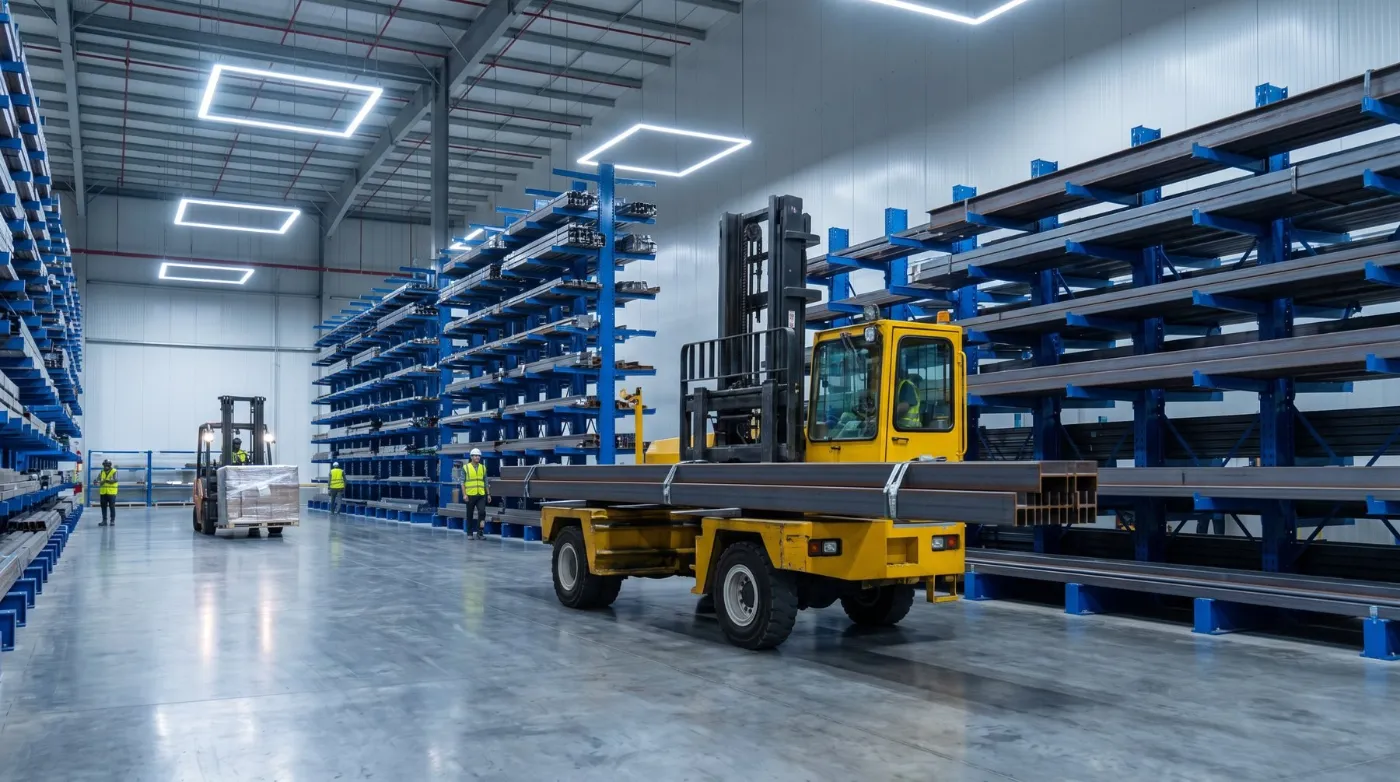
Side loaders and multi-directional trucks
Handling long products, pipes, profiles and bars, safely in narrow aisles and outdoor yards.
Intralogistics and automation
Racking, conveyors, AGVs and AMRs, and warehouse management systems for rail-side distribution centres that need to absorb volume quickly.
Three questions to ask before you scale up
01
Is your yard sized for trains, not trucks?
A train delivers many containers at once. Peak lifting capacity and yard layout matter more than average daily volume.
02
Is your equipment specified for the climate?
Summer temperatures well above 40°C, dust and long duty cycles call for the right cooling, filtration and components from day one.
03
Who keeps it running?
Uptime depends on spare parts, trained technicians and service response in the UAE, not on the factory datasheet.
Our take
Rail is turning the UAE’s industrial zones into inland gateways. The companies that gain the most will be the ones that plan their handling around the new flow early: right machines, right yard, right support.
That is where PMH Dubai Hub works every day, connecting Italian and European manufacturers with operators across the UAE and GCC, and helping them choose technologies that fit real applications.
Sources
1. Etihad Rail, AD Ports Group launch integrated rail service · Sharjah24, September 2026
2. UAE launches Abu Dhabi–Fujairah rail freight service · RailFreight.com, 25 September 2026
3. The Network · Etihad Rail
4. Etihad Rail Freight keeps UAE supply chains moving · ARN News Centre / Abu Dhabi Media Office, March 2026
5. UAE rail programme boosts port connectivity · International Chamber of Shipping, October 2022